
At Plunge Pools Newcastle, we work with local homeowners every week who are unsure about pool registration and safety rules. As an expert pool builder in the region, we provide professional guidance throughout the entire process. We design and install high-quality plunge pools across Newcastle and the Hunter region, and we guide clients through council requirements, approvals, and barrier compliance. Pool laws can feel complex. But when you understand how the New South Wales pool safety register works, the process becomes simple and clear.
In this complete guide, you will learn who must register, how the NSW Swimming Pool Register works, what compliance really means, and what steps to take if you are selling, leasing, or building a new pool. By the end, you will know exactly what to do next — and how to avoid fines or delays.
What Is the NSW Pool Safety Register?
The NSW Pool Safety Register is a free online database managed by Service NSW that records every swimming pool and spa in New South Wales. It includes details such as the property address, pool or spa type, year built, barrier information, inspection history, and any compliance certificates issued.
Registration is completed online through the Service NSW Swimming Pool Register portal on the official NSW Swimming Pool Register website, and there is no cost to register.
Each listing includes:
- Property address
- Pool or spa type
- Year built or estimated build period
- Barrier details
- Inspection history and compliance certificates
The register helps councils and certifiers know where pools are located and whether they meet current safety standards. Its purpose is simple: reduce drowning risk for children by keeping an updated safety record for every property.
Why Pool Registration Matters
Pool registration in NSW exists to reduce child drowning by ensuring every swimming pool and spa is officially recorded and traceable. It helps authorities identify where pools are located and whether they meet current safety standards.
Every year in Australia, young children lose their lives in backyard pool incidents — often due to preventable issues such as:
- A pool gate was left open
- A self-closing latch that failed
- A fence built below the required height
- Gaps or climbable objects near the barrier
The NSW Swimming Pool Register was created as a proactive drowning prevention measure. By requiring all pools capable of holding more than 300mm of water to be registered, the state ensures no residential swimming pool or spa goes undocumented.
Registration forms the foundation of enforcement. Without knowing where pools exist, councils cannot monitor safety compliance.
How the NSW Pool Safety Register Helps Councils
The register allows local councils and accredited certifiers to:
- Track the location of residential pools and spas across NSW
- Review pool inspection history and past compliance outcomes
- Monitor Certificates of Compliance and Certificates of Non-Compliance
- Verify safety status during property sales and leasing transactions
- Support the enforcement of NSW pool fencing laws and Australian Standards (AS1926.1)
This structured system improves transparency in the NSW property market and ensures pool safety checks are not overlooked when homes are sold or rented
Which Pools Must Be Registered?
In New South Wales, any swimming pool or spa capable of holding more than 300 millilitres of water must be registered on the NSW Swimming Pool Register. This requirement applies to permanent, temporary, residential, strata, and commercial pools.
Standard Backyard Pools
All in-ground pools, above-ground pools, indoor pools, and plunge pools must be registered if they meet the 300mm depth rule.
It does not matter how large or small the pool is. If it can hold water deep enough to pose a drowning risk, it must be recorded in the NSW Pool Safety Register under the Swimming Pools Act 1992.
This applies to:
- Concrete swimming pools
- Fibreglass pools
- Vinyl-lined pools
- Prefabricated plunge pools
Spa Pools and Swim Spas
Spa pools, hot tubs, and heated swim spas must also be registered in NSW.
Even if a spa has a lockable, child-resistant cover instead of a full perimeter fence, it still requires registration. In some cases, additional pool barrier requirements may apply depending on layout and access points.
Always confirm with your local council or an accredited pool certifier to ensure your spa pool complies with NSW pool fencing laws and Australian Standard AS1926.1.
Portable and Inflatable Pools
Many people are surprised by this rule:
Temporary frame pools and inflatable pools sold at retail stores must be registered if they can hold more than 300mm of water.
Depth is measured from:
The lowest internal point of the pool
to
The top edge of the pool wall
Even if you only install the pool during summer, registration is still legally required if it exceeds the 300mm water depth threshold.
Shared or Strata Pools
Pools located in:
- Townhouse complexes
- Apartment buildings
- Community title properties
- Gated residential estates
must also be listed on the NSW Swimming Pool Register.
In these cases, the owners’ corporation or strata manager is responsible for:
- Ensuring the pool is registered
- Arranging regular compliance inspections
- Maintaining valid Certificates of Compliance
Strata and multi-residential swimming pools are typically subject to stricter inspection cycles.
Business and Accommodation Pools
Pools at commercial and accommodation properties, including tourist accommodation, must also be registered, including:
- Hotels and motels
- Short-stay rentals and holiday homes
- Serviced apartments
- Visitor accommodation
These pools are generally inspected at least every three years because guests are unfamiliar with the property layout and safety features.
Regular inspections help ensure ongoing compliance with NSW pool barrier regulations and child safety standards.
Who Is Responsible for Registration?
The property owner is legally responsible for registering a swimming pool or spa on the NSW Swimming Pool Register. Responsibility may vary depending on the property type, but the legal duty always sits with the owner or controlling entity.
Pool Registration Responsibility by Property Type
| Property Type | Responsible Party | Important Notes |
|---|---|---|
| Owner-occupied home | Homeowner | Must ensure the NSW Pool Safety Register listing is accurate and up to date. |
| Rental property | Landlord | Property managers can assist, but the legal obligation remains with the owner. |
| Strata / Community title | Owners corporation | A strata manager typically handles registration and compliance tracking. |
| Tourist / Short-stay accommodation | Business owner | Formal inspections are usually required at least every 3 years. |
Registration links to the property, not the owner. When a property is sold, the record stays active.
How to Register Your Pool — Step by Step
Registering your pool on the NSW Swimming Pool Register is free, completed online through Service NSW, and usually takes less than 10 minutes. If your pool or spa can hold more than 300mm of water, registration is mandatory.
Step 1 — Gather Your Pool Details
Before starting the online registration process, have the following information ready:
- Property address
- Owner contact details
- Type of pool or spa (in-ground, above-ground, spa, inflatable, plunge pool, etc.)
- Approximate year built (or estimated construction period)
- Pool barrier details (fencing type, gates, child-resistant spa cover)
- Any recent upgrades or modifications to the barrier
Having accurate information ensures your NSW Swimming Pool Register listing reflects the current setup of your backyard pool or spa.
Step 2 — Visit the NSW Swimming Pool Register (Service NSW)
Go to the official Service NSW Swimming Pool Register portal.
- Open the Swimming Pool Register page
- Log in or create a Service NSW account if required
- Complete the online pool registration form
- Submit the declaration
After submission, you will receive:
- A confirmation email
- A Submission ID (proof of registration)
Keep both records safe. You may need them during a property sale, lease agreement, or council inspection.
Step 3 — Verify Your Pool Registration
After submitting the form, use the “Check a Property” tool on the NSW Pool Safety Register website.
Enter your property address to confirm your swimming pool or spa appears in the system. Once it shows as registered, your legal registration requirement is complete.
Keep your confirmation email and Submission ID as official documentation for future reference
Important Tip
Online self-registration is free.
If you prefer, your local council can complete the pool registration on your behalf, but they may charge a small administrative fee (typically around $10).
What Are the Most Common Pool Registration Mistakes to Avoid?
The most common NSW pool registration mistakes include incorrect details, failing to update changes, and confusing registration with compliance. These errors are easy to fix but can cause delays, fines, or problems during a property sale.
Avoid these easy-to-fix errors:
- Guessing the build year instead of checking records
- Forgetting to update barrier changes
- Thinking registration equals compliance
- Losing the confirmation email
The Golden Rule
Registration creates the record. Compliance proves safety.
Understanding the difference between pool registration and pool barrier compliance is essential for lawful and responsible pool ownership in New South Wales.
What Makes a Pool Barrier “Compliant”?
A pool barrier is compliant in NSW when it meets the requirements of the Swimming Pools Act 1992 (NSW) and Australian Standard AS1926.1, designed to prevent unsupervised access by young children. The primary goal is simple: stop children from entering the pool area without adult supervision.
Barrier Rules
To meet NSW pool fencing compliance standards, a compliant pool barrier must:
- Be at least 1.2 metres high from finished ground level
- Have self-closing and self-latching gates that open away from the pool area
- Maintain a non-climbable zone (NCZ) around the fence (usually 900mm clear space)
- Position the gate latches out of a child’s reach
- Have no gaps, footholds, or climbable objects nearby
This includes checking for:
- Loose hinges
- Worn self-closing mechanisms
- Pots, chairs, BBQs, or storage boxes near the fence
- Gaps under fencing
- Horizontal rails that could be used as footholds
Even small oversights can result in a failed pool safety inspection in NSW.
Spa Pools Without Full Fencing
In some cases, spa pools and hot tubs may use a lockable, child-resistant safety cover instead of full perimeter fencing.
However:
- The cover must meet Australian safety standards
- It must be securely fitted and lockable
- It must be kept locked when not in use
- Councils may still require fencing depending on the access layout
If access to the spa area creates risk, additional pool barrier requirements may apply.
CPR Sign Requirements in NSW Pool Areas
Every registered swimming pool in NSW must display a compliant CPR sign.
The CPR sign must:
- Be clearly visible from the pool area
- Show current, approved CPR instructions
- Be weather-resistant and easy to read
This requirement is mandatory under NSW swimming pool laws. While small, the CPR sign plays a critical role in emergency response and drowning prevention.
What Is the NSW Pool Self-Assessment Checklist?
The NSW Swimming Pool Register self-assessment checklist is an official compliance guide designed to help pool owners complete an effective review of their pool barriers against the Swimming Pools Act 1992 (NSW) and relevant Australian Standards (such as AS1926).
It is not a substitute for a formal inspection. However, it functions as a pre-inspection compliance tool that highlights the most common pool safety defects found during inspections across NSW.
This checklist is especially useful for:
- Homeowners preparing for a Certificate of Compliance
- Property sellers need a compliance certificate before settlement
- Landlords ensuring pool safety for rental properties
- Strata managers overseeing common property pools
- Owners of older pools are unsure which standards apply
Choosing the Correct NSW Pool Compliance Checklist
Not all pools are assessed under the same standard.
Your compliance requirements depend on:
- Pool construction date
- Property type (residential, strata, rental, holiday accommodation)
- Pool type (in-ground, above-ground, indoor, portable, spa)
- Whether the property is being sold or leased
Older pools may be assessed under earlier versions of the Australian Standards. Newer pools must meet updated barrier requirements.
When using the NSW Swimming Pool Register, match your pool’s build year to the appropriate checklist to ensure you are reviewing the correct compliance criteria.
If you are unsure of your pool’s construction date, check:
- Council approval documents
- Property records
- The NSW Swimming Pool Register entry
- Strata records (if applicable)
Using the wrong checklist can create confusion and lead to unnecessary upgrades.
What to Do After Completing the Self-Assessment
Once you complete your pool safety checklist:
1. Fix Any Identified Issues
Address minor repairs immediately. This may include adjusting hinges, tightening screws, trimming vegetation, or replacing latches.
2. Test Moving Components Multiple Times
Open and close the gate several times. Ensure consistent operation from different positions.
3. Take Photos of Repairs
Document repairs for your records. This is helpful if questions arise during inspection.
4. Keep Receipts
If you replaced hardware, signage, or fencing components, retain receipts as proof of corrective action.
5. Re-Check the Non-Climbable Zone
Make sure nothing has been moved back into the restricted area.
Proactive preparation can save days or even weeks of delay, especially during peak inspection periods in NSW.
When Do You Need an Inspection?
A pool inspection is required in NSW when selling, leasing, operating short-stay accommodation, or when compliance must be formally verified. Not every pool requires yearly inspections, but certain situations trigger mandatory checks under NSW swimming pool laws.
| Situation | Inspection Required? | Who Can Inspect |
|---|---|---|
| Tourist or short-stay accommodation | Every 3 years | Council or private certifier |
| Selling a property with a pool | Before sale | Council or private certifier |
| Leasing a property | Before lease | Council or private certifier |
| After barrier changes | Recommended | Council or private certifier |
After inspection, the result is uploaded to the register, and you receive either a Certificate of Compliance or Non-Compliance.
Selling or Leasing a Property
If you are selling or leasing a property with a pool in NSW, registration alone is not enough; you will usually need a valid Certificate of Compliance. This certificate confirms the pool barrier meets current NSW safety standards.
Why Registration Is Not Enough
Being listed on the NSW Swimming Pool Register only proves the pool is recorded.
When selling or leasing, you typically must provide either:
- A Certificate of Compliance, or
- A Certificate of Non-Compliance (which transfers repair responsibility under specific conditions)
Without the correct certificate attached to the contract or lease, the transaction can face complications.
What Happens Without a Certificate of Compliance?
If you don’t organise compliance early, you may face:
- Delays to property settlement
- Buyers requesting urgent repairs before the exchange
- Reduced negotiating power
- Insurers requesting proof of compliant pool fencing
- Extra stress during the marketing or contract stages
A small issue, such as a gate that fails to self-latch or a missing CPR sign, can unexpectedly stall a sale.
Plan Early to Avoid Delays
If you are preparing to sell or lease a home with a swimming pool in NSW, follow this practical approach:
- Use the NSW pool self-assessment checklist
- Inspect gates, hinges, latches, fence height, and non-climbable zones
- Replace or install a compliant CPR sign if required
- Fix minor defects immediately
- Book a pool compliance inspection before listing the property
Early preparation prevents last-minute panic.
Registration records the pool. Compliance enables the transaction.
Address small barrier issues early, organise your inspection ahead of marketing, and you’ll avoid unnecessary delays at settlement.
What Do You Need to Know Before Installing a New Pool or Spa?
Before installing a new swimming pool or spa in NSW, you must obtain council approval, comply with safety regulations, and prepare for mandatory pool registration. Pool safety and legal requirements begin well before construction starts.
Before You Build: Approvals & Planning
Most new pools in New South Wales require either:
- A Complying Development Certificate (CDC), or
- A Development Application (DA) approved by your local council
The approval pathway depends on your property and project type.
Before construction begins, check:
- Local zoning restrictions
- Bushfire-prone land status
- Flood overlays
- Heritage listings
- Lot size and boundary setbacks
- Easements or drainage constraints
Failing to secure the correct approvals can result in fines, stop-work orders, or forced modifications.
Check zoning, bushfire risk, and property type before work begins.
During Construction: Safety Comes First
While your pool is being built, NSW law requires strict safety measures.
- A licensed electrician must complete all electrical and pump-related work
- Temporary pool fencing must be installed if the pool can hold more than 300mm of water
- The temporary barrier must restrict child access until the permanent compliant barrier is installed
This is a critical stage for drowning prevention, even before the pool is finished.
After Completion: Registration & Compliance
Once your new pool or spa is complete, you must:
- Register the pool on the NSW Swimming Pool Register (Service NSW portal)
- Ensure the permanent pool barrier complies with the Swimming Pools Act 1992 (NSW) and Australian Standard AS1926.1
- Arrange a formal compliance inspection if required (especially for selling, leasing, or short-stay accommodation)
- Keep copies of:
- Development approvals (CDC or DA)
- Occupation Certificate (if issued)
- Barrier specifications
- Electrical compliance certificates
Registration is mandatory for all pools capable of holding more than 300mm of water — whether newly built or decades old.
Regardless of the builder you choose whether a local contractor or a specialist company such as North Sydney Plunge Pools, every new pool must still be registered on the NSW Swimming Pool Register and comply with barrier safety standards.
What Are the Penalties and Liability Risks for Non-Compliance?
Failing to register or maintain a compliant pool barrier in NSW can result in fines, council enforcement action, and serious legal liability. The risks extend far beyond a simple penalty notice.
What Happens If Your Pool Barrier Fails Inspection?
If your pool fencing does not meet NSW safety standards during inspection, you will receive a:
Certificate of Non-Compliance
This certificate lists specific issues such as:
- Non-functioning self-latching gates
- Insufficient fence height
- Climbable objects within the non-climbable zone
- Missing or outdated CPR signage
- Gaps that exceed legal limits
You are given a timeframe to fix the defects.
If you ignore the notice, councils can:
- Issue fines
- Order mandatory rectification works
- Begin formal compliance action
The Bigger Risk: Insurance and Legal Liability
The most serious risk is not the fine, it is liability.
If someone is injured or a drowning incident occurs in a non-compliant pool area:
- Your insurance claim may be denied
- Insurers may argue failure to maintain legal compliance
- Legal liability exposure increases significantly
- Civil action or negligence claims may follow
Non-compliance can weaken your legal defence in court, particularly if known defects were ignored.
How NSW Compares to Other States
New South Wales requires one-off pool registration with inspections triggered by sale, lease, or short-stay accommodation, unlike Victoria and Queensland, which mandate recurring inspection cycles.
| State | Registration System | Inspection Cycle | Key Difference |
|---|---|---|---|
| New South Wales | NSW Pool Safety Register | Inspections for sale, lease, or accommodation | One-off registration, local enforcement |
| Victoria | VIC Pool Register | Every 4 years | Regular re-inspection required |
| Queensland | QLD Pool Safety Register | Every 2 years (many properties) | Licensed inspectors only |
NSW uses a one-time pool registration system with inspections triggered by specific events, while Victoria and Queensland require regular, recurring inspections.
Regardless of state, maintaining a compliant pool barrier is essential not just for legal compliance, but for protecting children and reducing liability.
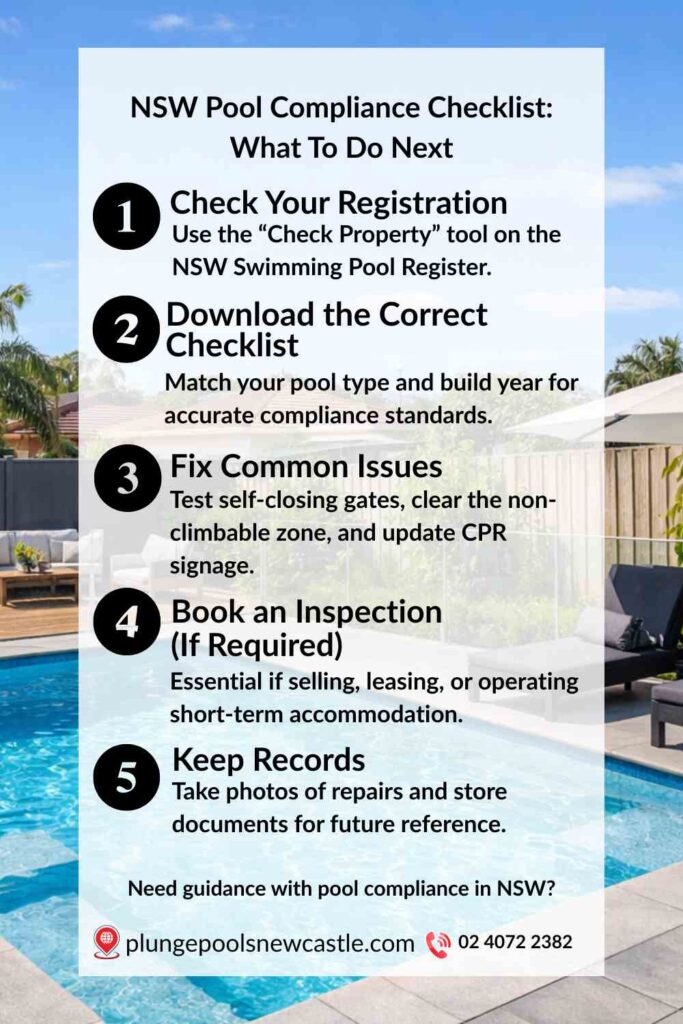
Practical Next Steps
If you own a swimming pool or spa in New South Wales, taking structured action now can prevent compliance issues later. Whether you are preparing to sell, lease, or want peace of mind, follow this clear step-by-step NSW pool compliance plan.
Here’s a simple plan you can follow today:
Conclusion
Pool ownership in New South Wales carries both freedom and responsibility. The New South Wales pool safety register exists for one clear reason: to protect children and create safer homes. Registration is simple. Compliance requires care. Together, they form a system designed to prevent tragedy before it occurs.
If you are unsure about your pool’s status, do not delay. Check your registration. Review your barrier. Fix small issues before they become serious ones. A secure gate. A clear CPR sign. A compliant fence. These are small measures with profound impact.
At Plunge Pools Newcastle, we believe safety should be built into every pool from the very beginning. We design and install high-quality plunge pools across Newcastle and the Hunter region, guiding homeowners through approvals, registration, and compliance requirements with clarity and precision. Whether you are planning a new pool or reviewing an existing one, our team is here to help you move forward with confidence.
Because a pool should bring joy, not uncertainty. And when safety is certain, peace of mind follows.
FAQs
1. How do I know if my pool fence meets current NSW standards?
Your pool fence meets NSW standards if it is at least 1.2 metres high, has a self-closing, self-latching gate, and maintains a clear non-climbable zone. Test the gate. Measure the height. Remove climbable objects. If unsure, arrange a licensed inspection.
2. What happens if my pool fails inspection?
If your pool fails inspection, you will receive a Certificate of Non-Compliance listing the required repairs. You must fix the issues within the allowed timeframe. After repairs, a re-inspection is needed. Delays can lead to fines from your local council.
3. Do I need a Certificate of Compliance to sell my home in NSW?
Yes, most homes with pools in NSW require a valid Certificate of Compliance before sale. Without it, settlement may be delayed. Some properties can transfer with a Non-Compliance Certificate, but this creates repair obligations and added risk for both parties.
4. How much does a pool compliance inspection cost in New South Wales?
A pool compliance inspection in NSW typically costs a few hundred dollars, depending on your location and inspector. Private certifiers may charge differently from councils. Costs increase if re-inspections are required due to failed barrier compliance.
5. If I build a new plunge pool, will it automatically meet NSW pool safety laws?
No, a new plunge pool does not automatically meet NSW pool safety laws. Compliance depends on correct approvals, barrier installation, and final inspection. When designed properly from the start, meeting the New South Wales pool safety register requirements becomes straightforward.