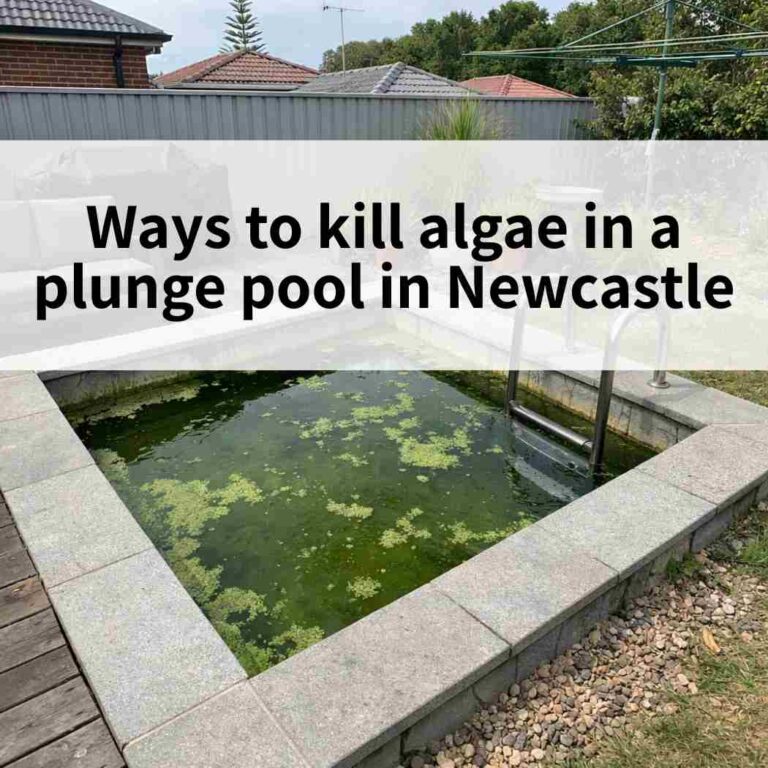

We help local homeowners keep their plunge pools clean, safe, and ready to swim. We design and build fibreglass and concrete plunge pools across Newcastle and the Hunter. We also guide our clients on water care, filtration, and long-term pool health. Coastal humidity, heavy rain, and strong sun can make algae grow fast. We understand how local conditions affect small plunge pools. This advice applies to any local pool exposed to coastal conditions.
In this guide, I will walk you through exactly how to kill algae in a plunge pool in Newcastle. You will learn why algae grows, how to identify the type, the correct shock levels, common mistakes to avoid, and how to prevent it from coming back. By the end, you will know what to do and when to call for help.
How to Kill Algae in your Pool?
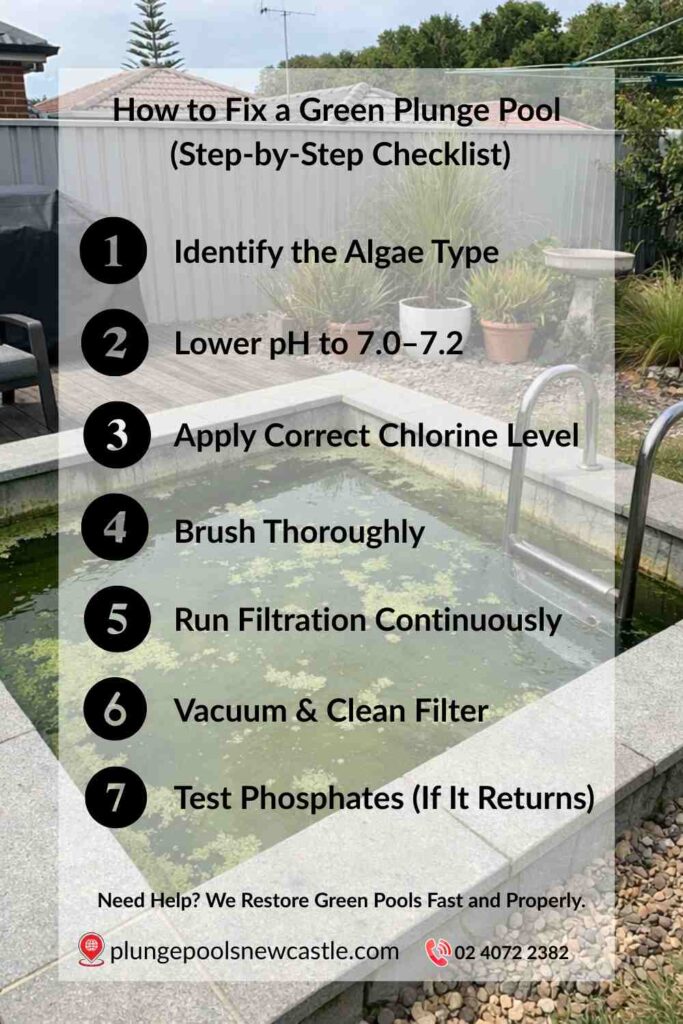
To kill algae in a Newcastle plunge pool, brush all surfaces thoroughly, lower the pH to 7.0–7.2, shock with liquid chlorine at the correct level, run the filter continuously for 24–48 hours, vacuum dead algae, clean the filter, and test phosphates if it returns.
If your plunge pool has turned green, cloudy, or slimy, here is the simple fix that works for most Newcastle homeowners:
- Brush every surface hard — walls, floor, steps, corners. Do not be afraid to scrub stubborn areas.
- Lower the pH to 7.0–7.2 — chlorine works best in this range.
- Shock with liquid chlorine at the correct level.
- Run your filtration system 24–48 hours non-stop.
- Vacuum the dead algae and clean the filter.
- Test phosphates if algae returns.
That is the direct path. No magic tricks. No shortcuts.
Why Algae Is Common in Newcastle Plunge Pools
Algae is common in Newcastle plunge pools because warm coastal temperatures, heavy rainfall, strong UV exposure, and organic debris rapidly reduce chlorine effectiveness, creating ideal conditions for algae growth.
Algae do not appear by accident. It grows when the conditions are right. And in coastal NSW, the conditions are often perfect.
Local Climate Factors in Newcastle
Newcastle has a mix of heat, moisture, and organic debris. These all feed algae growth.
- Humid coastal summers create warm water. Warm water speeds up algae growth.
- Sudden heavy rainfall dilutes chlorine levels.
- Strong UV exposure burns off free chlorine quickly.
- Leaf litter and gum tree debris add nutrients to the water.
After a storm, many homeowners notice their plunge pool turning dull or slightly green. This is not bad luck. It is chemistry reacting to the environment.
How Algae Actually Grows (The Simple Science)
Algae is a living organism. It needs three things:
- Low chlorine (below 2 ppm)
- High pH (above 7.6 reduces chlorine strength.
- Nutrients like phosphates
When chlorine drops too low, algae cells are not destroyed. They multiply. Fast.
Chlorine works by oxidation. It breaks apart the outer wall of algae cells. If the pH is too high, chlorine becomes weaker. It still exists in the water, but it loses power.
In warm Newcastle water, this reaction speeds up. Life grows faster in heat. That includes algae.
Why Plunge Pools Are More Sensitive
Plunge pools are smaller than traditional swimming pools. That makes them efficient. But it also makes them sensitive.
- Small water volume = fast chemical swings
- Chlorine depletes faster
- Filters clog quicker
- The risk of overdosing is higher
A standard backyard pool may hold 40,000 litres. A plunge pool might hold 10,000 litres or less. One storm, one busy weekend, or one missed test can shift the balance.
This is why many homeowners ask, “How do you kill algae in a pool properly so it doesn’t come back?”
The answer begins with knowing what type of algae you are dealing with.
Identify the Type of Algae First
Before you add chemicals, pause. Look closely at your water and surfaces.
Not all algae are the same. And if you treat the wrong type the wrong way, it will return.
In Newcastle plunge pools, we usually see three types.
1. Green Algae – The Most Common
This is the one most homeowners notice first.
What it looks like:
- Green or cloudy water
- Slippery walls
- Spreads quickly after rain
Green algae floats in the water. It grows fast when chlorine drops below 2 ppm. The good news is this: it is the easiest to kill.
If treated early, most fibreglass plunge pools clear within 24–48 hours.
2. Mustard Algae – The Sneaky One
Mustard algae looks like yellow or light brown dust.
What it looks like:
- Yellow patches on the walls
- Often in shaded areas
- Comes back after a normal shocking
It is more chlorine-resistant than green algae. It clings lightly to surfaces but spreads quietly.
Many Newcastle homeowners think it is just dirt or pollen. But if it keeps returning after brushing, it is likely mustard algae.
This type needs a higher shock level and longer filtration.
3. Black Algae – The Toughest to Remove
Black algae is less common in fibreglass pools. It prefers concrete.
What it looks like:
- Dark black or blue-green spots
- Hard, root-like structure
- Feels rough and stubborn
Black algae grows deep into porous concrete. It forms protective layers that shield it from chlorine. That is why simple shocking often fails.
It requires aggressive brushing and targeted chlorine treatment.
Step-by-Step Algae Removal
Algae removal is not guesswork. It is a sequence. Each step supports the next. If you skip one, the system fails.
Let us walk through it clearly.
Step 1 – Test and Record Your Water Chemistry
Before adding anything, test the water.
You need to measure:
- Free Chlorine (FC)
- Combined Chlorine (CC)
- pH
- Total Alkalinity (TA)
- Cyanuric Acid (CYA/stabiliser)
- Phosphates
Target levels before shocking:
- pH: 7.0–7.2
- CYA: 30–50 ppm
Why lower the pH first?
Because chlorine is stronger at lower pH, at 7.8, chlorine loses much of its power. At 7.2, it becomes highly active. In simple terms, you are sharpening the blade before you use it.
In small plunge pools, even small chemical changes matter. Measure carefully. Dose slowly.
Step 2 – Brush Aggressively
Brushing is not optional. It is essential.
Algae form a protective layer. Brushing breaks that shield. It exposes the cells so chlorine can destroy them.
Concrete plunge pools:
Use a stiff nylon brush. Brush daily during treatment.
Fibreglass plunge pools:
Use a soft brush. Focus on steps, corners, and low-circulation areas.
In Newcastle, homes with surrounding trees, shaded walls often hide growth. Pay attention there.
Brushing turns algae from attached growth into suspended particles. That is when chlorine can act.
Step 3 – Shock Treatment (Plunge Pool Specific)
For killing algae fast, liquid chlorine is best.
Why?
- No added calcium (prevents scaling)
- Mixes instantly
- Easier to control in small water volumes
- Reduces overdose risk
Below are the general target free chlorine levels:
| Condition | Target Free Chlorine |
|---|---|
| Light green water | 5–8 ppm |
| Moderate algae | 10 ppm |
| Mustard algae | 12–15 ppm |
| Black algae | 15+ ppm |
Maintain this level for 24–48 hours minimum.
Test every few hours if possible. If chlorine drops, top it up. In Newcastle heat, UV can burn chlorine quickly.
How Chlorine Actually Kills Algae
Chlorine works by oxidation.
It breaks apart the outer wall of the algae cell. The cell structure collapses. The organic matter dissolves into the water and forms chloramines.
Warm water speeds this reaction.
High pH slows it down.
That is why pH correction comes first.
Step 4 – Continuous Filtration Strategy
While chlorine does its work, the filter must run nonstop.
Run your pump 24 hours a day during treatment.
Backwash sand filters when the pressure rises to 8–10 PSI.
Clean cartridge filters daily during heavy outbreaks.
In small plunge pools, filters clog quickly. Dead algae collects fast. If filtration slows, water stays cloudy.
If you have a variable-speed pump, use medium to high speed during treatment. Strong circulation spreads chlorine evenly and improves the kill rate.
Step 5 – Vacuum and Remove Dead Algae
Once algae dies, it turns grey or white and settles.
Let it settle overnight if possible.
Vacuum slowly. Move gently. If you move too fast, you stir it back into suspension.
After vacuuming, clean the filter again.
This is where many homeowners stop too early. But removal is just as important as killing.
Dead algae left in the system become food for the next bloom.
Step 6 – Phosphate Removal (If It Returns)
If algae comes back within weeks, test phosphates.
If phosphates exceed 500 ppb, add a phosphate remover.
Why Phosphate Control Matters
Algae need nutrients. Phosphates are its fuel.
Phosphate removers bond chemically to phosphate molecules. They trap them so algae cannot use them.
Think of it as removing fertiliser from soil.
Without nutrients, even if chlorine dips slightly, algae struggles to regrow.
Special Treatment: Mustard Algae
(The one that keeps coming back)
Mustard algae is stubborn. It hides in shaded corners. It looks like yellow dust. Many homeowners brush it away, shock once, and think it is gone. Then it returns.
To remove mustard algae properly in a Newcastle plunge pool:
- Lower pH to 7.0–7.2.
- Shock to 12–15 ppm free chlorine.
- Maintain that level for 24–48 hours.
- Brush daily, especially shaded walls.
- Run filtration for at least 72 hours.
Mustard algae survives normal chlorine levels. It requires a stronger dose.
Important Step Most People Miss
Disinfect anything that touches the water:
- Swimwear
- Pool toys
- Cleaning brushes
- Pool covers
Mustard algae spores cling to fabric and plastic. If you put them back into clean water, the cycle begins again.
In Newcastle’s warm climate, this type spreads quietly. Treat it firmly the first time.
Special Treatment: Black Algae
(Mostly found in concrete plunge pools)
Black algae is different. It grows roots. It burrows into porous concrete.
If you see dark spots that do not brush off easily, you may be dealing with black algae.
Here is how to treat it:
- Use a stiff or stainless-steel brush (concrete only).
- Brush each spot hard to break the outer layer.
- Apply a chlorine paste directly to the area.
- Maintain 15+ ppm chlorine.
- Repeat daily until fading occurs.
Black algae protects itself with a thick outer shell. Brushing breaks that shield. Chlorine then reaches the roots.
Fibreglass plunge pools rarely suffer from black algae because the surface is smooth. Concrete pools are more vulnerable.
If black algae does not fade after 5–7 days of correct treatment, it may be time to call a professional pool technician in Newcastle.
Recovery Time Expectations
Not all pools recover at the same speed.
| Surface Type | Typical Recovery Time |
|---|---|
| Fibreglass plunge pool | 24–48 hours |
| Concrete plunge pool | 3–7 days |
| Severe outbreak | 7+ days |
Why the difference?
Fibreglass is smooth. Algae struggles to attach deeply.
Concrete is porous. Algae grips and resists removal.
Water temperature, circulation, and phosphate levels also affect speed.
Clear water is not just about appearance. It means balance has returned.
Common Mistakes Newcastle Pool Owners Make
In Newcastle, we see the same mistakes again and again. They are small. But they cause big problems.
1. Shocking Without Lowering pH
Many people add chlorine first.
But if pH is above 7.6, chlorine becomes weak. You may add a large amount, yet it does not work properly.
Lower pH to 7.0–7.2 first.
Then shock.
This small correction makes a big difference.
2. Not Brushing Properly
Algae builds a protective layer. If you do not brush, chlorine cannot reach the cells underneath.
Quick brushing is not enough.
Brush slowly. Press firmly. Focus on corners and steps.
In plunge pools, low-flow zones are common. These areas hide growth.
3. Under-Dosing Chlorine
Small pools make dosing tricky.
Some homeowners are afraid to add enough chlorine. Others add too little and stop early.
If the chlorine level does not reach the correct ppm for the algae type, it will survive.
Maintain the target level for 24–48 hours, not just a few hours.
4. Not Running the Pump Long Enough
Turning the pump off at night during treatment slows recovery.
Algae dies. It turns into particles. The filter must remove them.
During shock treatment, run filtration 24/7.
5. Ignoring Filter Cleaning
Dead algae clogs filters quickly.
If pressure rises and you do not backwash or clean cartridges, circulation drops.
Poor circulation = uneven chlorine distribution.
6. Letting Chlorine Drop After Heavy Rain
Newcastle storms dilute pool water.
Rain lowers chlorine. Debris adds nutrients.
After heavy rain, always test and adjust. Prevention is easier than recovery.
7. Skipping Phosphate Testing
If algae keep returning, nutrients may be high.
Phosphates above 500 ppb feed growth.
Without removing the nutrient source, algae may return even if chlorine is maintained.
Chemical and Environmental Risks to Be Aware Of
Killing algae is safe when done correctly. But there are risks if chemicals are misused.
Over-Chlorination
Too much chlorine can:
- Damage the fibreglass gelcoat
- Fade pool liners
- Cause strong odours
Small plunge pools are easier to overdose in. Measure carefully.
Metal Corrosion
Low pH combined with high chlorine can corrode:
- Metal fittings
- Ladders
- Heat exchangers
Balance matters.
Environmental Runoff
In Newcastle, chlorine-heavy water must not enter storm drains.
Always vacuum waste carefully. Avoid draining large volumes after shock treatment.
Skin and Eye Irritation
Red eyes and itchy skin are often caused by chloramines, not chlorine itself.
Proper oxidation and filtration remove these compounds.
Safety Protocol During Shock Treatment
Always follow basic safety steps:
- Wear gloves and eye protection.
- Add chemicals slowly.
- Keep the pump running while dosing.
- Never mix chlorine and acid directly.
- Ventilate enclosed plunge pool areas.
Water chemistry is a controlled science. When handled correctly, it restores balance safely.
Long-Term Prevention Strategy for Newcastle Plunge Pools
Killing algae is one thing. Stopping it from coming back is smarter.
In Newcastle, prevention must consider heat, humidity, storms, and leaf debris. A plunge pool needs steady care. Not heavy chemicals. Just balance.
Weekly Maintenance Plan
For most residential plunge pools in Newcastle:
- Test water once a week.
- Keep free chlorine between 2–4 ppm.
- Keep pH between 7.2–7.6.
- Brush walls and steps lightly.
- Empty skimmer and pump baskets.
Small pools change quickly. Weekly checks prevent sudden blooms.
Think of it like tending a garden. A little care avoids major repair.
Monthly Maintenance
Once a month:
- Test phosphates.
- Add a metal-free preventative algaecide if needed.
- Inspect filter condition.
If you live near gum trees or coastal wind zones, debris load may be higher. Nutrients enter more often.
Removing fuel prevents growth.
Seasonal Strategy for Newcastle
Summer (High Risk Period)
- Shock weekly during peak heat.
- Run pump 8–10 hours daily minimum.
- Test after heavy rain.
High UV burns chlorine quickly. Warm water accelerates algae growth.
Winter (Lower Risk, Not Zero Risk)
Algae slows down but does not disappear.
- Maintain chlorine at 2–3 ppm.
- Reduce pump time slightly but maintain circulation.
- Keep pH stable.
Many green pools appear in early spring because winter maintenance was ignored.
Treatment Strategy by Use Case
Different homes have different needs.
Residential Family Pools
Focus on a consistent weekly balance. Light brushing. Stable chlorine.
Routine wins.
Holiday Rentals & Airbnb Plunge Pools
Guest turnover increases contamination.
- Test between stays.
- Shock lightly before new arrivals.
- Inspect filtration closely.
Fast-clear water matters for reviews.
Heated Indoor Plunge Pools
Warm water + humidity increases risk.
Consider:
- UV-C sanitisation
- Enzyme systems
- Increased airflow
Heat speeds biological growth. Strong circulation and supplemental systems reduce recurrence.
Concrete vs Fibreglass: Which Handles Algae Better?
Many Newcastle homeowners ask this during pool installation.
Here is the simple comparison:
| Factor | Concrete | Fibreglass |
|---|---|---|
| Surface porosity | High | Low |
| Algae resistance | Lower | Higher |
| Cleaning difficulty | Harder | Easier |
| Recovery speed | Slower | Faster |
Fibreglass plunge pools are generally easier to keep algae-free in coastal humidity. The smooth surface leaves fewer places for spores to attach.
Concrete offers design flexibility but requires more brushing and monitoring.
Neither is immune. Balance is always key.
Chemical vs Low-Chemical Algae Treatments
Some homeowners prefer alternatives.
Here is a simple guide:
| Method | Pros | Cons | Best For |
|---|---|---|---|
| Chlorine-based shock | Fast, proven | Can irritate the skin | Quick outbreaks |
| Hydrogen peroxide | Eco-friendly | Slower | Small plunge pools |
| Enzyme systems | Preventative | Ongoing dosing | Year-round care |
| UV-C systems | Reduces chemical load | Higher upfront cost | Heated pools |
For active algae blooms, chlorine remains the most reliable solution.
Alternatives support prevention, not emergency treatment.
When to Call a Professional in Newcastle
You should consider calling a professional pool technician in Newcastle if:
- Black algae does not fade after 5–7 days.
- Chlorine will not hold above 2 ppm.
- The filter media is old or failing.
- Algae returns within 30 days.
- Water stays cloudy even after correct treatment.
These signs often mean there is a deeper issue poor circulation, hidden contamination, worn filter media, or high nutrient load.
Professional testing tools can measure factors that home kits may miss.
DIY vs Professional Algae Removal Cost Comparison
Here is a simple comparison for homeowners in Newcastle:
| Method | Approximate Cost | Effectiveness | Time Required |
|---|---|---|---|
| DIY (liquid chlorine shock) | $40–$80 | High (for green algae) | 1–3 days |
| DIY (enzyme or UV support) | $120–$250 | Moderate | Ongoing |
| Professional service | $180–$300 | Very high | 1–2 days |
For light or moderate green algae, DIY works well when done correctly.
For black algae or repeat outbreaks, professional service often saves time and frustration.
Sometimes the cheapest option is the one that fixes the problem the first time.
Quick-Action Checklist
If your plunge pool turns green, follow this order:
Do not rush the sequence.
Water balance is a system. When the system is corrected, clarity returns.
A Final Word for Newcastle Homeowners
In Newcastle, our coastal air, heavy rain, and strong sun make plunge pool care a little more demanding. But with steady testing and simple prevention, algae becomes rare. Prevention is always faster and cheaper than recovery.
If you are unsure about your water balance, struggling with recurring algae, or planning to install a new concrete or fibreglass plunge pool, we are here to help. We at Plunge Pools Newcastle are the experts and install high-quality plunge pools built specifically for Newcastle conditions. We also guide local homeowners with practical advice on water care, filtration, and long-term maintenance.
If your pool keeps turning green, or you simply want expert guidance tailored to your backyard, reach out to Plunge Pools Newcastle today. We understand our coastal climate, and we are always ready to help you keep your water clear, safe, and ready to enjoy.
Next Steps
The bigger the pool, the more algae. If you’re wondering now how big or small a plunge pool can be, check out our previous article!
FAQs
1. How much liquid chlorine should I add to kill algae in my plunge pool?
Add enough liquid chlorine to reach 10–15 ppm free chlorine for most algae. For a typical 10,000-litre plunge pool, that is usually around 1–1.5 litres of 12.5% liquid chlorine. Always calculate based on pool volume. Precision prevents damage and ensures a complete kill.
2. Why does my pool turn green again after heavy rain in Newcastle?
Your pool turns green after heavy rain because rainwater dilutes chlorine and adds debris. Lower chlorine plus added nutrients allows algae to grow quickly. After storms in Newcastle, always test water and rebalance chlorine and pH immediately to prevent blooms.
3. Why won’t my chlorine level stay up even after shocking?
Chlorine will not stay up if algae is still consuming it, or if phosphates or high stabiliser (CYA) levels are present. The chlorine is being used faster than it can be replenished. Test CYA and phosphates to solve the root cause.
4 . How often should I shock my plunge pool in summer?
Shock your plunge pool once a week during peak Newcastle summer. High UV and warm water reduce chlorine quickly. Weekly shocking restores strength, removes contaminants, and prevents algae before it becomes visible.
5. When should I call a professional instead of fixing algae myself?
Call a professional if black algae persists beyond 5–7 days, chlorine will not hold, or algae returns within a month. These signs suggest deeper circulation, filtration, or nutrient issues that require expert testing and correction.